

See every node
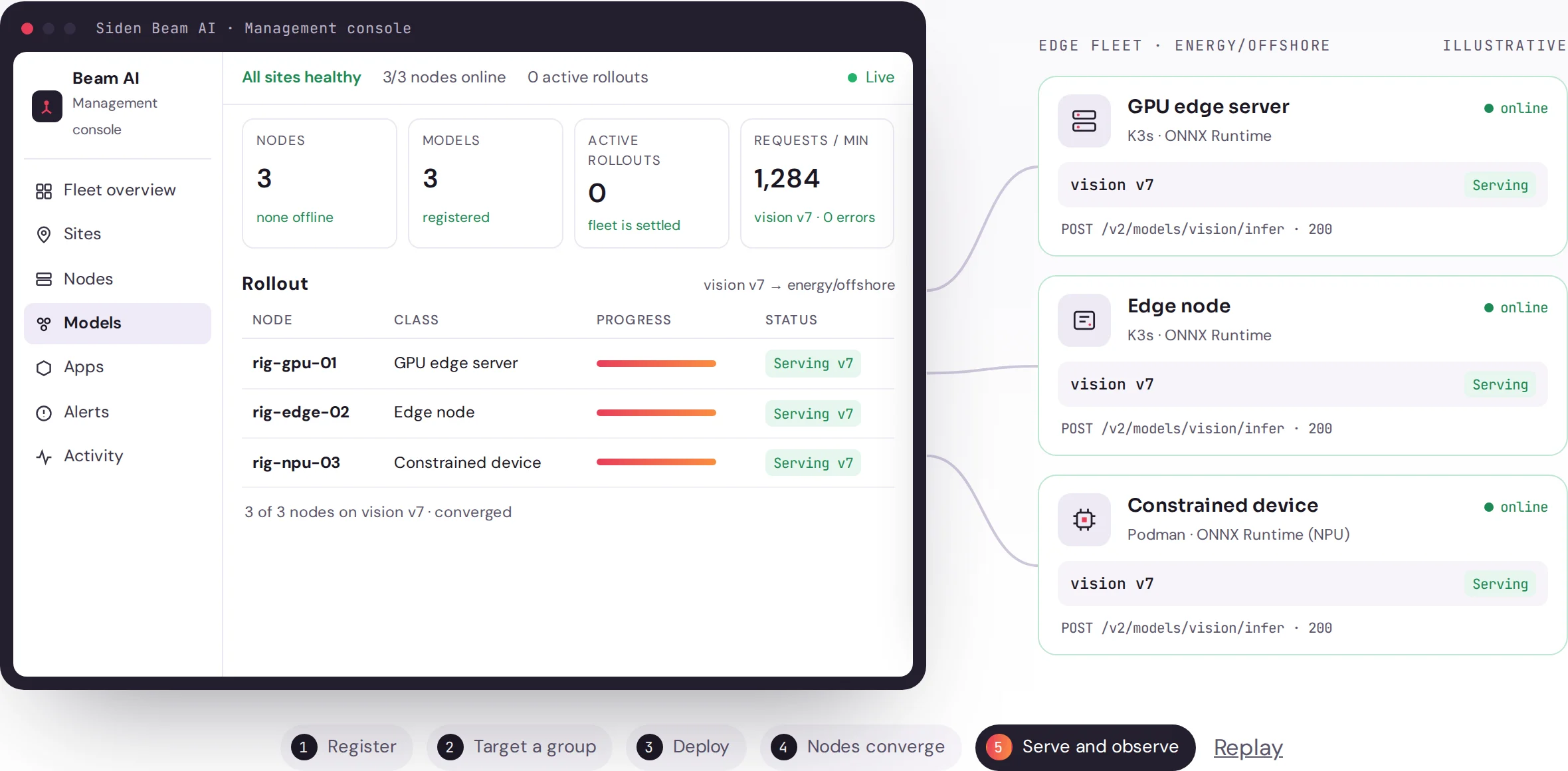
One inventory across every location, with CPU, memory, GPU/accelerator, storage, and connectivity health. Failed workloads restart or reschedule automatically.
Fleet and node management
Run your whole edge AI fleet from one console. Every site, every node, every model version, with one-step rollback when an update misbehaves.
Built for operations inMiningManufacturing & RoboticsEnergy / Oil & GasDefenseSecurityRetailTransportation & LogisticsAviation & Maritime
of edge AI deployments reach full production.
Spectro Cloud, State of Edge AI (320 respondents)
name model lifecycle (updates, accuracy drift, version consistency) as a blocker, the most-cited of any.
Fierce Sensors Edge AI Survey with the EDGE AI Foundation, April 2026 (74 completed)
Teams wire together separate tools for orchestration, model serving, and fleet management, and still struggle to keep every node on the right version.
Push a trained model to many sites and keep it running, up to date, and under control.
One inventory across every location, with CPU, memory, GPU/accelerator, storage, and connectivity health. Failed workloads restart or reschedule automatically.

Group nodes into footprints by location, hardware class, or label, then deploy a model to the whole footprint. Each model is served behind OpenAI-compatible or KServe v2 endpoints.

Every model is a versioned artifact with a record of what runs where. Push updates over the air and roll back in one step if something goes wrong.

Request volume, latency, and error rate per model, next to node health, with alerts when something needs attention.
Every operation is an API call. Deploy, check status, update, and roll back from CI/CD, or let AI agents do it through the MCP server.
Move AI models from development into production faster, without lengthy deployment cycles.
Cut manual deployment effort, simplify remote management, and limit unnecessary cloud data transfers.
Expand AI deployments across locations and devices without managing each environment separately.
Support local AI inference and reduce dependence on continuous cloud connectivity.
Before Beam AI, Siden built and operated edge platforms in homes, on aircraft, and on vessels, over networks that drop, stall, and come back. Beam AI is built on that experience, for AI.
You declare what should run; every node converges on it. The control plane holds which models, at which versions, run on which nodes. A node that loses its link keeps operating and catches up when connectivity returns.
Equipment health and safety monitoring on haul trucks, conveyors, and processing plants
Less unplanned downtime and safer sites
Visual quality inspection, predictive maintenance, and vision models on robots
Less downtime, higher quality, and one update rolled out to every line at once
Remote equipment monitoring and anomaly detection at wells, pipelines, and substations
Faster issue detection and fewer field visits
Sensor fusion and situational awareness on forward-deployed systems
Faster decisions at the tactical edge, with inference that keeps running when disconnected
Video analytics, perimeter monitoring, and access control across sites
Faster threat detection and fewer false alarms reaching operators
In-store analytics, shelf and inventory monitoring, and loss prevention
Fewer stockouts and faster insight into store operations
Fleet analytics, asset tracking, and yard and warehouse monitoring
Greater visibility and faster decisions
Onboard AI inference with intermittent connectivity
Lower cloud dependency and better onboard services
Beam AI deploys and serves the models you have trained. It does not train them, and it is not tied to one cloud.
A control plane for deploying, serving, and operating AI models across a fleet of edge devices, from one console.
No. Beam AI deploys and serves the models you have trained. It does not train them, and it is not tied to one cloud.
Join the waitlist. We'll be in touch about next steps, including a pilot on your own nodes.
Two. A central control plane (console plus API) holds the desired state: which models, at which versions, run on which nodes. A lightweight agent on each edge device carries out instructions locally and reports status back.
ONNX, GGUF, safetensors, and TensorRT.
Both. Language models are served behind an OpenAI-compatible API, and vision and predictive models behind the Open Inference Protocol (KServe v2).
Yes. Multiple models run side by side on a node, each behind its own standard API, and can be added or removed on demand.
Every model is versioned. You push updates over the air to a footprint, and roll back in one step if something goes wrong.
Yes. Every operation is an API call, so you can deploy, check status, update, and roll back from CI/CD, or let AI agents do it through the MCP server.
Request volume, latency, and error rate per model, next to node health (CPU, memory, GPU, storage, and connectivity), in one console, with alerts when something needs attention.
Beam AI detects the failed workload and restarts or reschedules it automatically. Minimal on-site work is a core design goal.
Linux edge nodes, on K3s or MicroShift, from CPU and NPU devices to GPU servers.
Small CPU or NPU devices with no accelerator work, as long as they run Linux and a container runtime.
No. Bring your own. Beam AI is hardware-agnostic, from GPU edge servers to small devices.
It keeps running the model it has. When connectivity returns, it catches up to the latest desired state automatically.
Inference runs locally, so raw data such as video and sensor streams stays at the edge. The control plane holds operational state (which models and versions run where) and telemetry such as request rates and health, not your raw inputs.
Beam AI is built for constrained and intermittent networks. Nodes keep serving their models through long outages and catch up automatically when the link returns. The control plane runs in Siden’s secure cloud, and data is encrypted in transit. For specific security requirements, talk to us.
A fixed-fee pilot on your own hardware, run alongside your team in four milestones: enroll your nodes, register a model, deploy it, then run a staged update across your footprints. We agree success criteria up front, and you keep everything we configure.
A couple of Linux edge nodes to start, a trained model in a supported format, and a target use case. We handle the platform.
Typically a platform fee plus a per-edge-node subscription, scoped to your fleet. Pilots are fixed-fee.
Start with a pilot: see it deployed, served, observed, updated, and rolled back on your own fleet.